2018 Lincoln Navigator First Drive: Aluminum for the win
 2018 Lincoln Navigator First Drive: Aluminum for the win
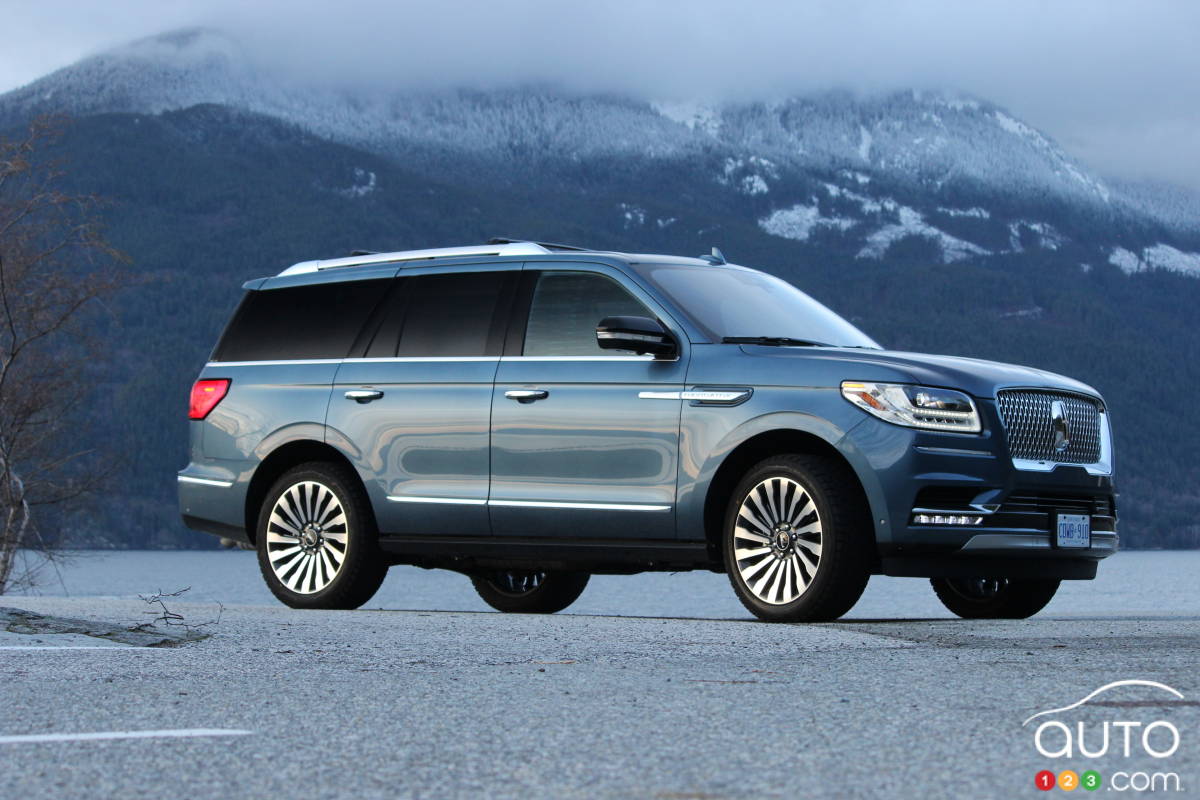
Now that Ford has begun rolling out its all-new, aluminum-bodied Expedition for the masses, it’s time we switch our focus to that model’s luxury variant, the Lincoln Navigator. Like the Expedition, it’s got an aluminum-alloy body as well as a single powertrain: a 3.5L EcoBoost turbo mated to a 10-speed automatic transmission and AWD. That’s your only choice in Canada; Americans get a RWD model. It’s available in two trims – Select (MSRP $87,500) and Reserve (MSRP $90,500) – each of which can be had in either short- or long-wheelbase form (long wheelbase models cost $90,500 and $93,500, respectively). The US gets an even more luxurious Black Label trim, but we’re not seeing that in Canada. Not yet, anyway.
Here’s the thing, though; when I sampled the Expedition in late 2017, it was so good that I actually found myself wondering what the heck the Navigator would do to move the chains enough to warrant earning luxury brand status, as well as a $3,651 price jump at base over the top-spec Expedition Max long wheelbase.
We travelled the gorgeous Sea-to-Sky Highway between Vancouver and Whistler, BC to find out.
Aluminum digs
As mentioned before, the Navigator now has an aluminum-alloy body. You can feel the weight savings as soon as you open the doors (and no; they aren’t of the gullwing variety as seen on the Navigator Concept at the 2016 New York Auto Show); they’re light to the point where I found myself slamming them overly hard on more than one occasion. The other place where you can really tell the difference is when lifting the hood. While only about 0.00006 per cent of eventual Navigator owners are going to do this more than twice a year, it does well to demonstrate just how much has changed after the switch to aluminum.
While it remains a little heavier than the Expedition, it still sets off from a standstill with gumption, even ferocity if you leave it in the “Excite” drive mode. Yes; “Excite” is the actual name, and it joins Conserve, Normal, 4x4 Auto Normal, Slippery, Deep Conditions and Slow Climb, all of which can be accessed by spinning the console-mounted wheel. As an added bonus, the gauge cluster changes depending on what mode you’re in; “Normal”, for example, leaves you with a single gauge – the speedometer – which is cool in that only the speed you’re going lights up as all the other numbers ‘round the speedo stay hidden. It’s a neat way of helping drivers focus on their speed. Then, when you switch to “4x4 Auto Normal”, you get a tach, too, so you can get a better look at what the powertrain’s up to. The fact that each switch is accompanied by a different hi-res graphic is icing on the cake.
Read more